Education is a fundamental right and key to social justice. At MBM, we believe it breaks cycles of poverty, creating opportunities for those facing a lack of prospects and opportunities. In this article, we discuss how an integrated approach to private social investment in education can drive the future.
João grew up in a neighborhood where dreams and reality seemed not to interact. Driven by survival, he dropped out of school to work in the informal market and never had the opportunity to learn to read and write again. When he became a father, he wanted something different for his son, but, lacking resources and references about the importance of education, he ended up distancing him from the school routine by suggesting that he accompany him to work.
This fictional story represents the experience of many Brazilians, where the lack of access to knowledge and opportunities perpetuates a cycle of poverty that impacts 28% of the Brazilian population in 2024.According to Datafolha research, 73% of young people want to return to school but find themselves in the same reality as João's son, where they need to work to help their families.
Current state of education in the country
Multidimensional poverty goes beyond lack of income and reflects a widespread lack of rights and access to essential resources, such as education. Stories like João's exemplify this reality, where the absence of educational opportunities limits the development of an entire family and community cycle. Today in Brazil, it takes nine generations for the descendants of a Brazilian situated among the poorest 10% to reach the country's average income level.
Although education is a fundamental right guaranteed by the 1988 Constitution, its universalization in Brazil is still far from being achieved. The challenges are significant: of the country's young people (18-29 years old), 8.8 million have not completed high school and do not attend any basic education institution, according to data collected by the PNAD Contínua (Continuous National Household Sample Survey). Considering all age groups, there are more than 68 million citizens without basic schooling in the country. In 2021, under the effects of the pandemic, only half of the children living in households among the poorest 20% of the population were involved (in person or virtually) in school activities throughout the week, while this was the case for three out of four children in the wealthiest families.
According to Todos Pela Educação (All for Education), in recent years Brazil has faced a worrying increase in the illiteracy rate, a drop in the IDEB (Basic Education Development Index), and a reduction in the quality of teacher training, especially among those who opt for distance learning courses.
Our vision
In the Bem Maior Movement, we see education as a transformative force, capable of building a future with fairer opportunities and breaking the cycle of poverty. We believe that education is the key to building a more equitable and inclusive society. For João and his son to understand the value of learning, a broad approach is needed, one that encompasses the educational context in all its dimensions.
Literacy or after-school program initiatives, if implemented in isolation or on a one-off basis, are not sufficient. Our vision is comprehensive and considers different levels and demands of the education system. This includes everything from the professionalization of school management and teachers to the formulation of pedagogical and governance policies, in line with guidelines, such as the "Todos Pela Educação" (All for Education) mandala below.
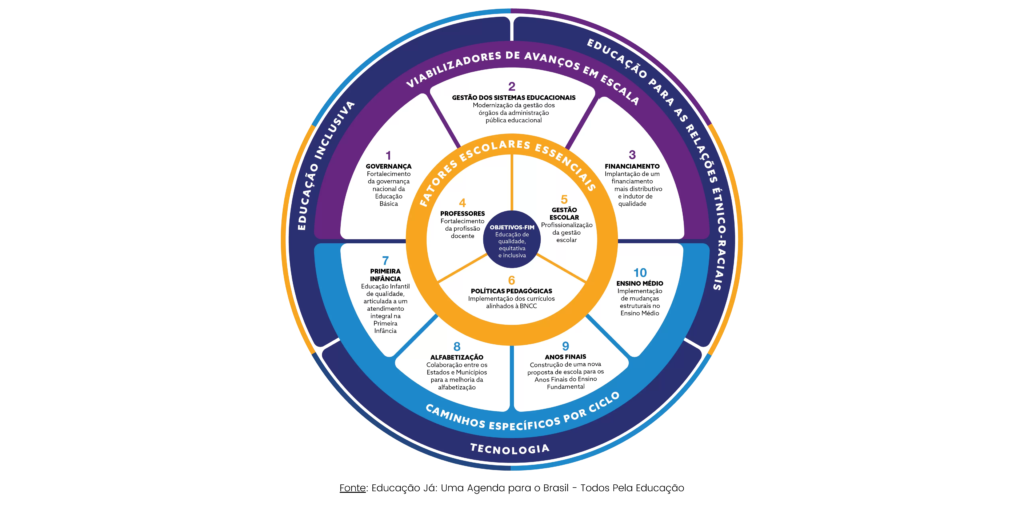
It is precisely this refined vision of Brazilian education that makes Todos Pela Educação (All for Education) a fundamental piece. The organization operates at the national level to influence public policies and ensure that basic education is prioritized, inclusive, equitable, and of high quality. Through its strategic action, Todos Pela Educação promotes guidelines to address the main challenges of education in the country, creating a common agenda in coalition with other social organizations committed to quality and accessible education for all.
Organizations like the iungo Institute, focused on the technical qualification of teachers, are essential to ensure the quality of learning and the technical improvement of educators in the face of contemporary challenges. To this end, it is also important to support and be close to organizations like Parceiros da Educação (Education Partners), which works in the training of Education Directorates in São Paulo through the Sul 1 and Sul 2 projects, strengthening school management to improve educational outcomes.
Another strategic example is the Rodrigo Mendes Institute, which promotes school inclusion through inclusive training programs, empowering schools and Secretariats for accessible education.
Paying attention to social demands and recent political movements, we have directed efforts among these organizations towards the articulation and implementation of the National Common Curriculum Base (BNCC). The Movement for the Base plays an important role in this process, connecting different actors and ensuring that the defined practices effectively reach Brazilian territories.
These are some of the organizations in our portfolio in the education sector, highlighting the importance of addressing the complexity of the educational challenge as an interconnected and systemic issue, rather than an isolated one.
Starting point for social transformation
Investing in education means rewriting stories like João's, offering new perspectives for future generations. João's journey, and that of so many other families, shows that poverty is perpetuated by a lack of opportunities. Through actions that encompass diverse educational dimensions, MBM aims to be a bridge between untapped potential and human and social development.
By supporting education, we pave the way for a more promising future, where every young person can be an essential link in the transformation of society, overcoming local barriers and inspiring a positive impact that spreads throughout the country.
What do you think about starting to integrate this perspective into your philanthropic practice?
Stay up-to-date on all the latest news for investors and social organizations, curated by the Bem Maior Movement, as well as updates on our work. Subscribe now to Radar MBM, our exclusive newsletter! Receive firsthand, every month, relevant content about philanthropy, social initiatives, and ways to make a difference far beyond donation! Join us! Subscribe



 ">
">