The philosopher Angela Davis's quote helps to understand the role of women leaders in the non-profit sector:
"When a Black woman moves, the entire structure of society moves with her."
By analyzing the position of women at the base of the social pyramid, simultaneously affected by inequalities of race, class, and gender, Davis points out that it is precisely from this position that forces emerge capable of challenging and reconfiguring entire structures.
In Brazil, this leading role is evident. Women represent approximately 65% of the workforce in the third sector, according to the Map of CSOs (Ipea, 2023), and are the majority at the forefront of social initiatives. They reorganize power relations, create new forms of coexistence, and produce solutions that resonate far beyond the immediate space.
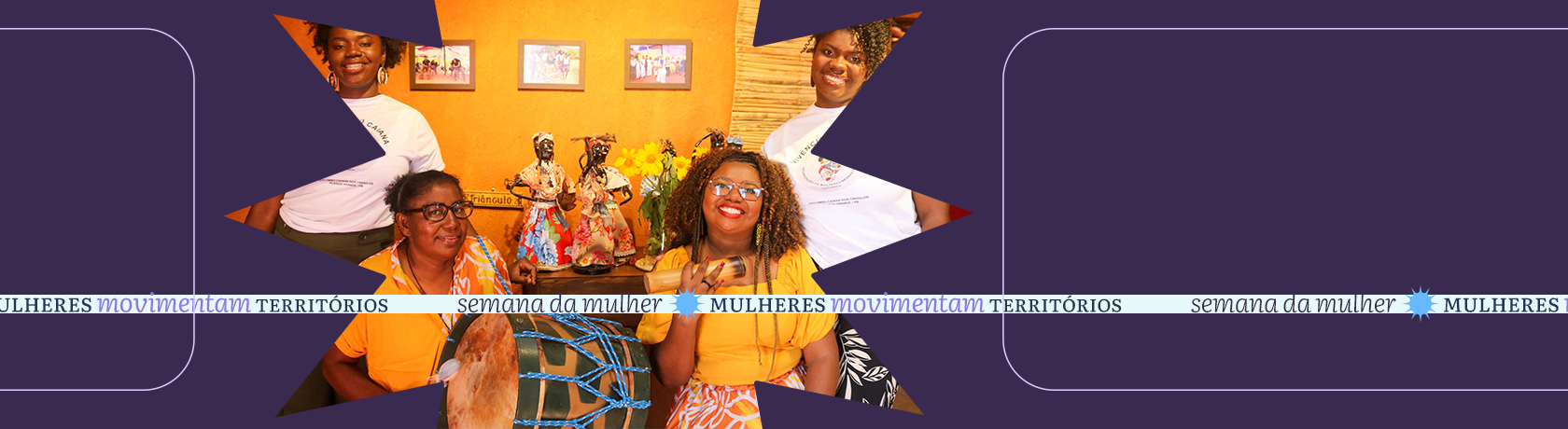
It is in this context that the Women's Month campaign, " When a woman leads, the territory moves with her, " is situated. This campaign stems from listening to community leaders from the Futuro Bem Maior to shed light on something that already happens, but is still little recognized: the central role of women in sustaining and transforming territories.
Female leadership that emerges from the territory
The leadership of these women is not built from a distance nor mediated by external models. It emerges from lived experience, from the continuous relationship with the territory, and from the ability to articulate local knowledge with practical solutions.
In the Quilombo Caiana dos Crioulos, in Alagoa Grande (PB), the trajectory of Luciene Tavares, from the Organization of Black Women of Caiana , shows how leadership and belonging go hand in hand. She witnessed the construction of the community school, was a student, and returned as a teacher. Her work demonstrates that education, in these contexts, is not limited to formal access, but becomes an instrument of cultural continuity and identity affirmation, by "bringing the knowledge of our culture into the classroom," as she states.
This same movement is repeated in other territories. In São Sebastião da Boa Vista (PA), the work of Socorro Gomes, from Arte em Fibra de Jupatí , provides development through culture. Her pride lies in "rescuing our culture and tradition passed down from generation to generation and helping women to have an extra income through handicrafts." There, income generation, autonomy, and cultural preservation are built in an integrated way.
The redistribution of power in the territories
If leadership originates from the territory, its impact is amplified when it is organized collectively. In many contexts, this means displacing historical power structures.
As Rosanegra Batista, from the Rede Elas Negras Conexões network in Cachoeira (BA), points out, for a long time decisions were concentrated in the hands of men. When she states that "we women can be at the forefront of decisions and local transformation," she highlights a concrete change in community dynamics.
This movement materializes in actions that cut across different dimensions of social life: income generation, strengthening self-esteem, access to rights, political mobilization, and care networks.
In Quilombo Caiana, the work translates into the articulation of different agendas, as Luciene Tavares explains when highlighting the work in "political advocacy, education, health, and confronting racism and violence against women." The work is multifaceted because the challenges are also multifaceted, and inequalities overlap.
Who supports the third sector in Brazil?
The centrality of women leaders in the third sector is structural. According to the Map of CSOs (Ipea, 2023), women represent about 65% of the workforce in the social field. On the front lines of peripheral initiatives, this number is 68%, according to the research "Peripheries and Philanthropy" by the PIPA Initiative .
This means that they are the ones who sustain, on a daily basis, the functioning of community organizations, projects, and networks throughout the country.
However, this prominence coexists with persistent inequalities. The massive presence of women does not necessarily translate into proportional access to funding, recognition, or adequate working conditions.
The invisible challenge for women in the third sector
Despite the impact generated and the capacity for mobilization, the sustainability of these initiatives remains one of the biggest challenges faced by women in the third sector.
In different territories, keeping organizations active often depends on volunteer work and multiple roles. Leaders need to balance their work in these initiatives with other sources of income and domestic responsibilities, which in practice amounts to triple work shifts.
The data reinforces this scenario: 31% of peripheral organizations operate with less than R$ 5,000 per year, according to research by the PIPA Initiative. This reveals a mismatch between the relevance of the work done and the resources available.
The words of Eliete Oliveira, from the Papagaio Residents' Community Association , in Valente (BA), help to illustrate this reality by highlighting that "the lack of stable financial resources is a major challenge," coupled with the difficulty of keeping women engaged in the face of the multiple responsibilities they accumulate.
Furthermore, as Rosanegra Batista , there are persistent structural barriers, such as the historical absence of public policies and difficulties in accessing information, technology, and training.
Another key point is the overlap between institutional, community, and affective work. As Joelma Gomes, from the Rainhas do Mar Institute , located in the Recôncavo Baiano region, reflects, this care is a "political force and support for the territory," but it is rarely recognized or funded as an essential part of management.
Investing in women leaders in the third sector strengthens territories
Experiences such as the Mangue Delas program, from the Instituto Rainhas do Mar, show how it is possible to articulate training, territory, and knowledge based on a logic that integrates technical and traditional knowledge, recognizing ancestral practices as social technologies.
This same logic appears in different contexts: in income generation, in the mobilization for rights, and in the construction of support networks.
Eliete Oliveira summarizes , "when several groups unite, they transform realities." And this transformation lies, above all, in the capacity for collective articulation through networks, exchanges, and joint actions.
Joelma Gomes further emphasizes that transforming the territory does not mean carrying the world alone, but building collectively, sharing responsibilities, and recognizing care as a political strategy.
When a woman moves, the territory moves with her
Angela Davis's phrase becomes a concrete reality in the daily lives of women leaders in the non-profit sector.
When a woman leads, knowledge is valued, rights are claimed, local economies are strengthened, and networks are consolidated. Gradually, the entire territory is mobilized.
The stories and the data point in the same direction: the solutions already exist in the territories and are being conceived and built by women.
The question that remains for investors is about decision-making: are we creating the necessary conditions for leaders like these to grow with structure and continuity?


 ">
">