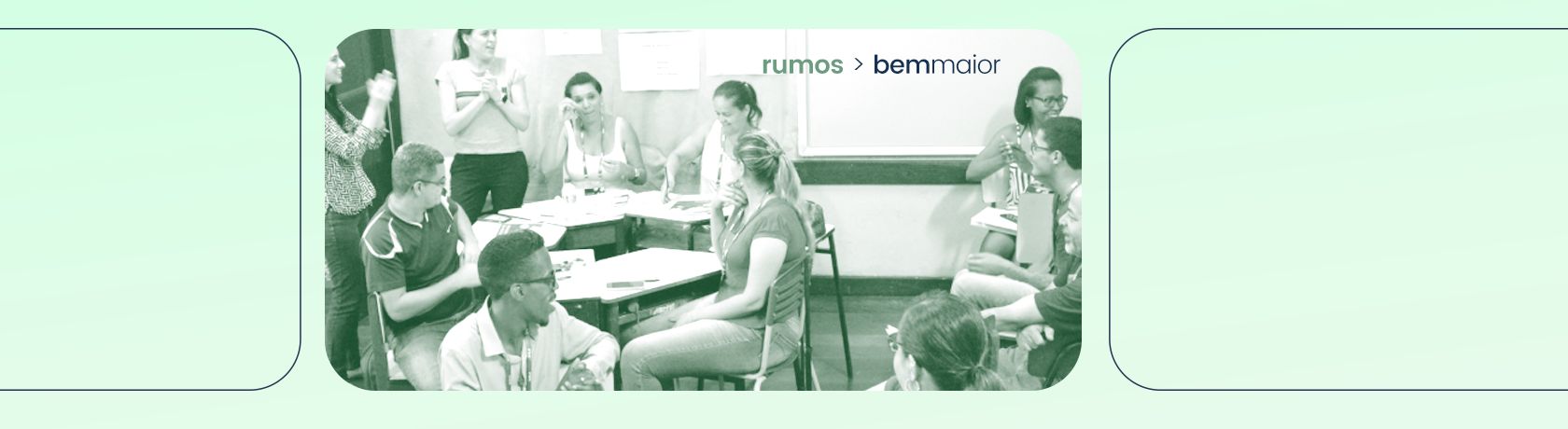
The collective participated in the Futuro Bem Maior, carried out by the Bem Maior Movement, Phomenta, and Instituto Phi, aimed at strengthening initiatives with community impact.
“Itatuba” is an ancestral term, from the Tupi language, meaning “place of many stones.” This name not only describes the geography but also encapsulates the essence of a municipality in the Metropolitan Region of Campina Grande, Paraíba, which has just over 10,000 inhabitants, according to the Brazilian Institute of Geography and Statistics (IBGE 2011). Among the residents is Shirley Luis da Silva, a teacher for 25 years and a member of the Multividas Collective, an organization that supports rural workers in living with the semi-arid climate and in defending human rights.
Daughter of farmers, Shirley understood from a very young age that this was fertile land, made up of people as strong as rocks, but with few opportunities. More than half of the region's inhabitants depend on family farming for their livelihood, supplementing their income with government programs such as Bolsa Família and retirement benefits.
“We emerged from the experience of the base ecclesial communities. It was a group of rural chapels that met at that time to discuss the journey of each chapel, in 1994. When this group emerged, it was religious, but over time we also saw other issues, sharing the potential and weaknesses of each community,” comments the educator. “The name, Coletivo Multividas (Multilives Collective), was created later, when the Pastoral Service for Migrants arrived and joined, bringing with it the water access program. One of the major problems of rural exodus in the municipality of Itatuba was the migration of the population from rural to urban areas due to lack of water.”
The initiative expanded and services were broadened, encompassing not only families in Itatuba, but also those in the municipalities of Fagundes and Ingá. “In addition to the cisterns, we have other activities geared towards farmers and agriculture, such as economical ecological stoves. Besides reducing gas costs, they utilize firewood available in the community itself, without harming nature, and allow for the preparation of cakes, savory snacks, and other varieties that families can sell and contribute to their household income,” Shirley points out.
Another strength of the collective, which participates in networks such as the Agreste Leadership Forum and the Northeast Solidarity Fund, is the maintenance of banks of native seeds. At fairs and meetings, dialogues are established with society about the importance of conserving these grains and denouncing contamination by GMOs, pesticides, and climate change.
“Today, we have a seed bank in the Mãe Joana community; a seed bank in the Serra Velha community, in Itatuba; a seed bank in the municipality of Ingá; and this year, we will create another one in Agrovila Águas de Acauã, a resettlement that houses families affected by the construction of the Acauã dam,” he shares. “We talk about everything from seed storage to planting and all this training, about living with the semi-arid environment, so that farmers can be protagonists of their own story, around their homes, in their fields. We want them to be able to plant and harvest to prepare their food safely and without poison. The main objective is the family. The maintenance and survival of the family.”
Futuro Bem Maior
Despite their tireless work, wisdom, and positive impact, the Collective felt the need for management tools and strategies to achieve even more success stories. That's how Multividas discovered the Futuro Bem Maior program, a collaboration between the Bem Maior Movement, Phomenta, and the Phi Institute, dedicated to strengthening community initiatives.
The program, now in its 4th edition, supports relevant social organizations with limited resources in areas of high social vulnerability. Through capacity building, it seeks to promote the leadership of these groups, enabling them to achieve their mission with quality and in a sustainable manner.
“When we looked at the call for proposals, it was perfect for us, as we weren't formally registered. It was our opportunity. That's why we, from the Multividas Collective, participated and, thank God, we were approved,” he recalls. “We thought it was a window of opportunity, but it has already opened many doors, because we are putting it into practice. We are taking the step towards formalizing Multividas, obtaining our CNPJ (Brazilian tax ID). We will expand our services in the seed banks of rural communities. Before, we lost several calls for proposals because we didn't have a CNPJ, so this opportunity went beyond that, allowing us to get organized.”
The cycle lasts two years. In 2023, the selected organizations explored challenges, outlined strategies, and designed projects that will be implemented now, in 2024, with seed capital of 70,000 reais. “It’s even difficult to describe this experience. The training enabled not only the continuity of the project, with the funding in the second year, but also a complete understanding of the organization,” shares Shirley. “The ‘Greater Future’ gave us the opportunity to evaluate ourselves, to plan so we can start over. Not starting over by leaving behind everything we’ve experienced. Without abandoning our foundation, our essence, but seeing the fruits we have to reap. We filled our baggage with knowledge, and now it overflows to the other people who are part of Multividas.”
This year, the Collective will celebrate its 30th anniversary, and the professor sees this moment as an opportunity to test new strategies. “We understand the importance of visibility. We were a group that only acted within the community; now we have a different view of the importance of social media, not only to give visibility to our actions but also to promote family farming products,” she says. “Another very important change was in the matter of recording activities. Recording the services provided, the people served, the changes. Today we are in this organizational process. We were a collective without concrete data; we witnessed through actions and stories, but we didn't have records, so we are building our database based on the lessons learned during our training.”
From now on, the idea is to further strengthen all the learning and attract more supporters who can guarantee the continuity of the mission. Like the seeds they work so hard to preserve, the members of the collective now also seek to sow their stories and ensure that good practices are passed down through generations. “I hope that our collective will be formalized and able to access new funding opportunities. These can give opportunities to the beneficiaries supported by Multividas, farmers, especially young people living in rural areas. We want to empower them, we want them to become protagonists of their own story, so that they can contribute within their community,” shares Shirley. “We want to increase people's passion for their land, so that young people don't have the illusion of wanting to leave their origins for large urban centers. Migration is a right, but it shouldn't be forced. We hope they don't abandon their homeland, their space, their stories, and their roots due to a lack of opportunities. Our wish is that the people of the countryside have a vibrant semi-arid region where they can live well.”



 ">
">