Launched to strengthen the Brazilian public health system (SUS) during the pandemic, the Emergency Health Fund distributed R$40 million to hospitals and charitable institutions in 25 states.
Broadcast live by Folha, late in the afternoon of this Monday (7), this year’s special edition of the award focused on the response to Covid-19. And one of the winners was the Emergency Fund for Health, led by women, social entrepreneurs, who joined forces to work for a single purpose: to help the Brazilian health system.
Read the full article published by Folha about the Emergency Fund for Health.
. . .
Emergency Fund for Health
Idis, BSocial and Movimento Bem Maior organizations
Entrepreneurs Paula Fabiani, Mariana de Salles Oliveira and Carola Matarazzo
Websites idis.org.br / bsocial.com.br / Movimentobemmaior.org.br
Carola Matarazzo (Movimento Bem Maior) and Mariana de Salles Oliveira (BSocial) were caught off guard on July 27th during a meeting with HSP (Hospital São Paulo), when the state was registering 10,000 new COVID-19 cases per day.
At the meeting, they represented the Emergency Health Fund, which they founded with Paula Fabiane, president of Idis (Institute for the Development of Social Investment), to help charitable hospitals and philanthropic institutions during the pandemic.
The video call about the use of funds allocated by the fund to HSP became a kind of virtual thank-you ceremony. The ICU team recounted how the disease changed their routine; with the 1.9 million received, the hospital bought new medication injection pumps, which freed professionals from the difficult task of choosing which patients would receive treatment and which would go without.
“We were facing an unknown enemy. We lacked information and infrastructure; we didn't even have enough safety equipment,” says Manuel Girão, director of the Paulista School of Medicine at Unifesp and president of the strategic council of Hospital São Paulo.
He recalls that, during his initial contact with the fund managers, he even doubted the idea of a fund aimed at helping hospitals; it seemed too good to be true.
"Amid so much suffering, it was a relief to spend days and nights working to support those on the front lines," says Paula.
It was a collaborative effort to raise resources, a joint effort between the economist, the psychologist Mariana, and the administrator Carola.
The trio subverted the saying that goes, "Those who want to go fast, go alone. Those who want to go far, go together."
"The fund taught us that it's possible to go fast and far at the same time in the face of the advancing pandemic in the country," says Paulo.
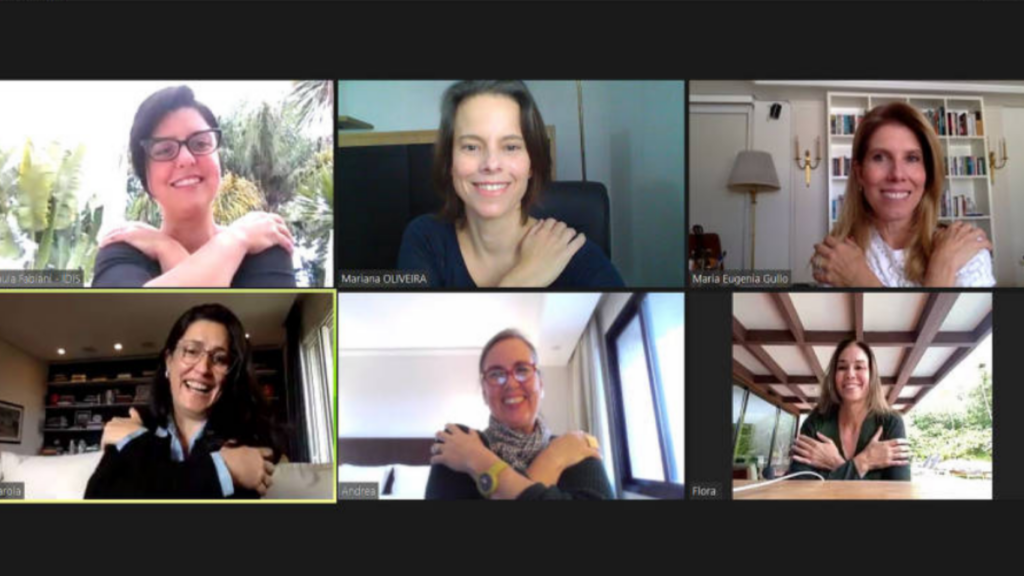
Meeting of the six-woman team leading the Emergency Health Fund, an initiative that distributed R$ 40 million to healthcare during the pandemic. / Press release
An experience marked by the strength of the feminine, since the 3 leaders of the initiative had the support of journalist Andréia Wolffenbuttel (Idis) and the other two co-founders of BSocial, Maria Duva Gullo and Flora Botelho.
"It was a decentralized, networked effort, where a focused and ego-free team was formed, working towards an urgent and unique purpose," describes Carola.
Paula attributes the fund's success to female leadership: "Women have a genuine concern for purpose, and that made all the difference."
Aware of the COVID-19 situation in other countries and the exponential demand for hospital beds, the group of six women decided that the focus of the emergency fund would be strengthening the Brazilian public health system (SUS).
Thus, the social entrepreneurs and their teams lost sleep and weekends searching for resources.
In 5 months, they raised over R$40 million. The amount surprised Paula, who had initially aimed to raise R$5 million.
"For every R$ 5,000, we celebrated," she recalls, seeing the total amount of resources multiplied by eight.
The key to their success was how they organized themselves for the action. Carola and Paula led the teams from Idis and the Bem Maior Movement to close partnerships and attract major donors among philanthropists and companies.
Meanwhile, Mariana was mobilizing the staff at BSocial, an online donation platform, to reduce their fees as much as possible and attract individual donors.
“It’s a purposeful alliance, which makes the work agile, mature, and organized, without ego involved,” says Mariana, highlighting the expertise of the organizations as social actors and the culture of giving.
In total, they secured more than 10,000 donors, including companies of all sizes and from various sectors, individuals, and family organizations focused on philanthropy.
This is how 53 cities in 25 states across the country had their philanthropic Santa Casa hospitals strengthened during a critical time.
The selection of the beneficiary hospitals was rigorous, guided by a technical council formed by doctors Marcos Kisil, José Antônio de Lima and José Luiz Setúbal.
The difficult task of choosing which hospitals would receive donations and which would be left out involved the pro bono work of PLKC Advogados and Sitawi Finanças do Bem, who handled the legal and financial aspects of the fund.
And they achieved something unprecedented: "For the first time, hospitals didn't need to ask for contributions; we were the ones who went after them and brought them to them," says Carola, who has been spreading the good news throughout almost the entire country.
Mariana highlights the impact on the teams involved: "Upon learning of the donation, the professionals were moved, they felt seen, with their efforts for health recognized for the first time."
Cláudio Bonduki, a professor of gynecology at the Paulista School of Medicine, who acted as a liaison between the fund and the São Paulo Hospital, says that meeting Carola was a joy.
"With the help of the fund, we were able to structure ourselves and care for those infected in a humane and effective way. We are very grateful to the women of the Emergency Health Fund."
"Besides the satisfaction of contributing to the SUS (Brazilian Public Health System), Carola sums up the feeling behind the initiative: 'Knowing that I was able to help save at least one life already makes me extremely grateful.'"
And thousands of lives were saved, in a count that is still not settled.
– – –
Emergency Fund for Health
- Thousands of people impacted
- R$ 40 million in resources mobilized
- 60 institutions from 25 states benefited.
- 16 charitable healthcare institutions received funds from the fund.
- 2.8 million pieces of PPE distributed
- 125,000 COVID-19 tests performed
- 653 donated hospital equipment items ready
This article was originally published on the Folha de São Paulo website.
Image Credit: Press Release/MBM